
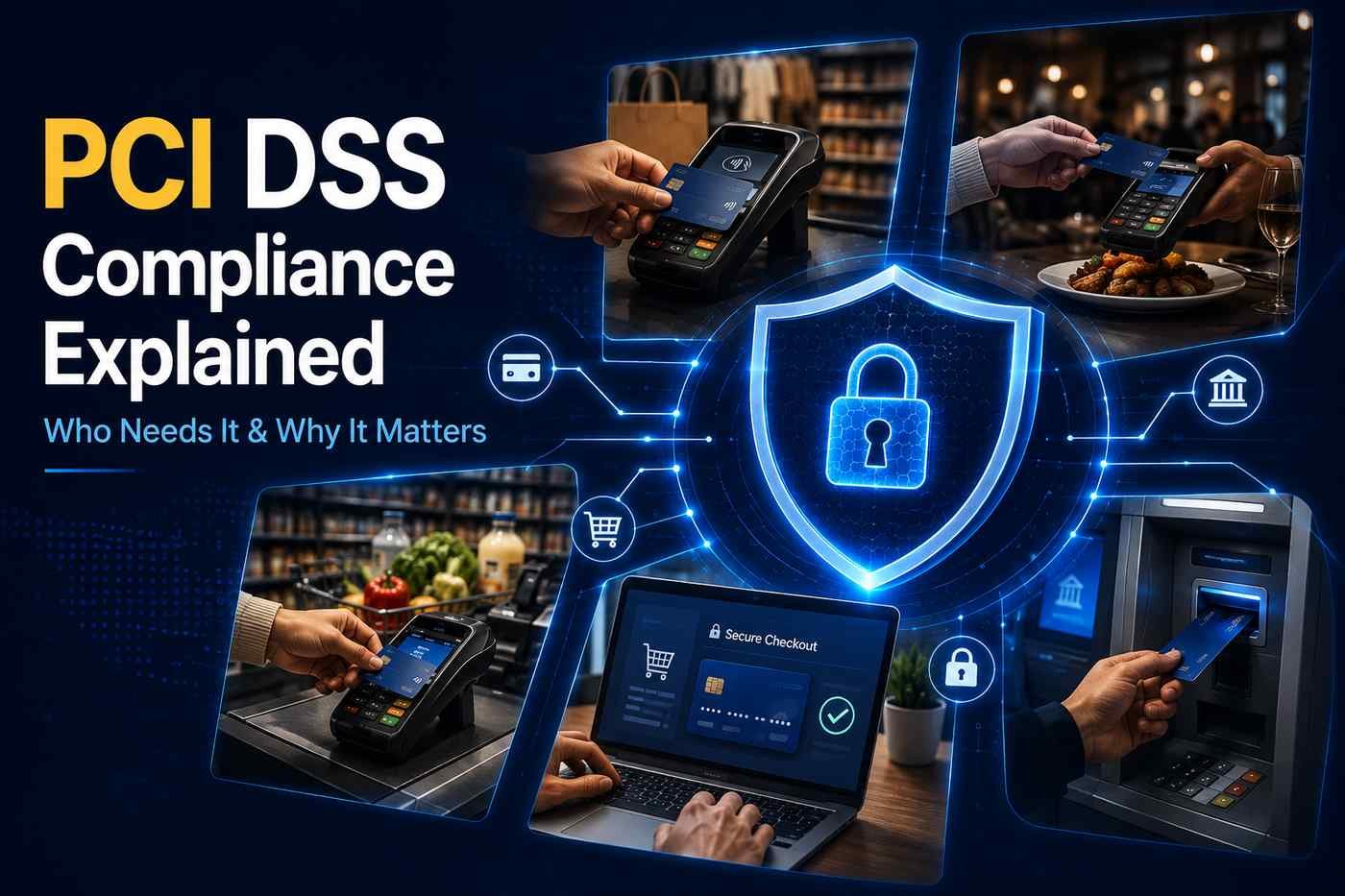
What Is PCI DSS Compliance?
Payment Card Industry Data Security Standard (PCI DSS) is a global data security standard for businesses of any size or sector that handle cardholder data or accept payments through debit/credit cards.
It helps ensure businesses are well-protected and keep their cardholder data and payment systems secure.
PCI DSS is not a law; it is a set of mandatory security requirements enforced by payment card brands through acquiring banks.
Which Businesses Need To Meet PCI DSS Requirements?
Regardless of size or sector, any business that stores, processes, or transmits customers' card payment data may need to comply with PCI DSS requirements.
Examples:
A retail store that accepts debit/credit card payments from customers.
A hotel that accepts online card payments for room bookings.
A payment gateway or payment service provider that processes card transactions.
An e-commerce website that accepts card payments online.
12 High-Level PCI DSS Security Requirements
The following are the 12 high-level PCI DSS v4.0.1 security requirements, explained in simple terms.
| Requirements | What It Means | |
| #1 | Install and Maintain Network Security Controls | A firewall or other strong network security controls should be implemented and maintained |
| #2 | Apply Secure Configurations to All System Components | Systems should be securely configured, and unnecessary components should be removed or disabled |
| #3 | Protect Stored Account Data | Protect stored cardholder account data using appropriate security measures, including encryption where required. Avoid storing it in plain text. |
| #4 | Protect Cardholder Data with Strong Cryptography During Transmission | Cardholder data should be protected using strong cryptographic protocols during transmission |
| #5 | Protect Systems Against Malicious Software |
Systems and networks should be protected from harmful software |
| #6 | Develop and Maintain Secure Systems and Software | Systems and software should be securely developed and maintained by identifying and addressing security vulnerabilities. |
| #7 | Limit Cardholder Data Access Based on Business Need | Only authorized users and systems should have access to cardholder data based on their business needs |
| #8 | Identify Users and Authenticate Access to System Components | Businesses should use the correct authentication mechanism, including unique user IDs, and enable MFA where it is needed. |
| #9 |
Secure Cardholder Data and System Components from Unauthorized Physical Access | Physical access should be restricted and monitored in areas where cardholder data is stored and processed |
| #10 |
Log and Monitor System Activity | Relevant system activity should be logged and monitored to help detect suspicious activity. |
| #11 |
Regularly Test Security Systems and Processes | Regular vulnerability assessments and penetration testing should be performed on applicable internal/external systems |
| #12 | Strengthen Information Security Through Organizational Policies and Programs | Businesses should maintain information security policies, security management processes, employee awareness programs, and an incident response plan |
Importance of PCI DSS Compliance
1) Helps protect cardholder data from unauthorized access
2) Spreads awareness by providing training to employees on social engineering and phishing attacks
3) Reduces cyber risk and the risk of financial losses
4) Helps secure businesses’ internal/ external systems by identifying and addressing vulnerabilities
5) Helps businesses create a documented incident response plan
Why Do businesses Need PCI DSS compliance?
Businesses that are PCI DSS compliant can help improve payment security and protect cardholder data. It helps ensure that businesses are better protected from cyber fraud and can decrease the risk of financial losses. This also helps build customer trust when making payments online.
How Verentix Can Help
At Verentix, we help businesses meet compliance requirements with our compliance and security services. We understand how necessary PCI DSS is for businesses that manage card payment data.
Businesses that are preparing for PCI DSS compliance can identify security weaknesses through Vulnerability Assessment and Penetration Testing (VAPT), which can help identify vulnerabilities across web applications, APIs, cloud environments, and other security systems.
Need help with this topic?
Our security experts can assess your specific situation and provide actionable recommendations.
Talk to an Expert